
What Time Is It in French 11+ Ways: How to Ask and Tell Time in French


Want to learn how to say what time is it in French in under 15 minutes?
What about how to ask and tell time in French? All of this is important to knowledge to have whether you plan on visiting a French-speaking country, if you want to practice for a school exam, or if you are attempting to become fluent in French.
The good thing is, we can help! We have laid out exactly what you need to know to ask for the time and tell the time in French using both a 12-hour and 24 hour clock (military time).
Bonne Chance!
What Time Is It in French

To specifically ask what time is it in French, you can always use the most standard form which is: Quelle heure est-il?
🥐 Pro Tip: Heures in French translates literally to hours but people understand it as time
This is both polite and formal enough to say to anyone. Whether you are speaking to a friend, your boss, or a complete stranger, this sentence will be acceptable.
Here is a very short and quick video on how to ask what time is it in French and how to answer using the 12-hour clock. This is a brief introduction to the topic, but it’s a great start if you only want to know one way asking and answering the time in French!
If you aren’t familiar with French numbers yet, then I highly recommend reading through my post on Learning to Count from 1-10+ in French (with Pronunciations) before you continue with this post. Otherwise, you may get a little frustrated or discouraged which never quickens the learning process.
What Time is it in French Pronunciation
To pronounce what time is it in French or Quelle heure est-il, either watch the first video in this post or follow these syllable pronunciations:
✔️ Quelle – ‘KELL’
✔️ Heure – ‘ERR’
✔️ Est-il – ‘ETSEEL’
It’s quite simple, luckily for us! Quelle is pronounced like the first syllable in the name “Kelly”, Heure is pronounced with a silent h and a long r sound, and est-il is pronounced when you swap the s and t in est for ets and pronounce il like the word “eel”.
Thus, what time is it French to English ⮕ Quelle heure est-il? = What time is it?
How do you Say What Time Is It in French?

Did you know that there are actually dozens of ways to ask what time is it in French?
It’s true! Depending on who you are talking to, it’s possible to hear a great range of verbiage when it comes to asking or telling the time.
Below is a list of ways to ask the time in French, along with a few notes for each one like when to use it and its translation.
🥐 1. Quelle heure est-il?
This is the most common and standard way of asking the time in French. It’s formal, polite, and can be used between friends, family, strangers, and coworkers.
🥐 2. Est-ce que vous avez l’heure?
This is the longer, more drawn-out version of asking “do you have the time?” in French.
If you were talking to a complete stranger or your boss, this would be acceptable, however, it isn’t truly necessary at any time.
🥐 3. À quelle heure?
If you want to ask someone “at what time?“, then you would use this form.
It is less formal than the previous two statements, so it’s typically only used between people who know each other. Otherwise, it can come off as rude or impolite.
🥐 4. Quelle heure?
Even simpler than the previous statement, to ask “what time?“, simply say Quelle heure. Again, you wouldn’t just walk up to a random person on the street and yell “what time?!”, would you? No.
So, don’t use this unless you are talking with someone about a specific gathering, event, and so forth. Plus, if you are doing this, then you probably know the person very well.
🥐 5. Vous avez l’heure?
This is a less polite and more informal way of asking “do you have the time?” in French. You would typically only say this to someone you know or have at least met before, but if you were to say it to someone you don’t know it would still be acceptable.
Since the phrase uses vous which is the formal tense, it’s still appropriate, but just a bit less formal.
🥐 6. Tu as l’heure?
Now, if you were to use this phrase, it would be very informal. Since it uses the phrase tu which is the informal tense, it doesn’t still translate to “do you have the time”. Instead, it translates to “you got the time?” or “hey, what time is it?“
Therefore, definitely do not use this phrase unless you know the person. If you do accidentally, don’t be surprised if the person gives you a smirk and walks away without telling you.
Here is a great video to help you with learning how to tell time. If you already know the French number system, you can start here!
Why is Saying Il Est Quelle Heure Controversial?
🥐 7. Il est quelle heure?
Saying this phrase is a bit controversial since it comes off as “it is what time?” which is both awkward to say and grammatically incorrect.
It eludes that someone already told you the time and you are confused, concerned, or surprised by their answer.
If you ask someone the time using this phrase, they may act strange when they tell you, almost as if they’re wondering why you’re acting concerned.
What are the Most Polite Ways of Asking What Time is it in French?

🥐 8. Avez-vous l’heure?
This is a formal way of asking “do you have the time?”
🥐 9. Auriez-vous l’heure?
A very formal way of saying “would you have the time?” or “would you happen to have the time?“
🥐 10. Vous auriez l’heure?
Just a slightly different way of asking “would you have the time?” in French, like #9.
🥐 11. As-tu le temps?
A much less formal way of asking “do you have the time?” in French. Only use this verbiage with someone you know very well since it uses the informal tense, tu.
How Do You Tell the Time in French?
Learning how to tell time in French is not difficult, but it does take practice. To become proficient in the art of telling time in French, practice on both 12-hour and 24-hour clocks and use the time in conversation on a regular basis.
To get started, we’re going to give you all of the phrases for telling the time in French using the 12-hour clock. From there, you can practice using the 24-hour clock once you are familiar with the sentence structure.
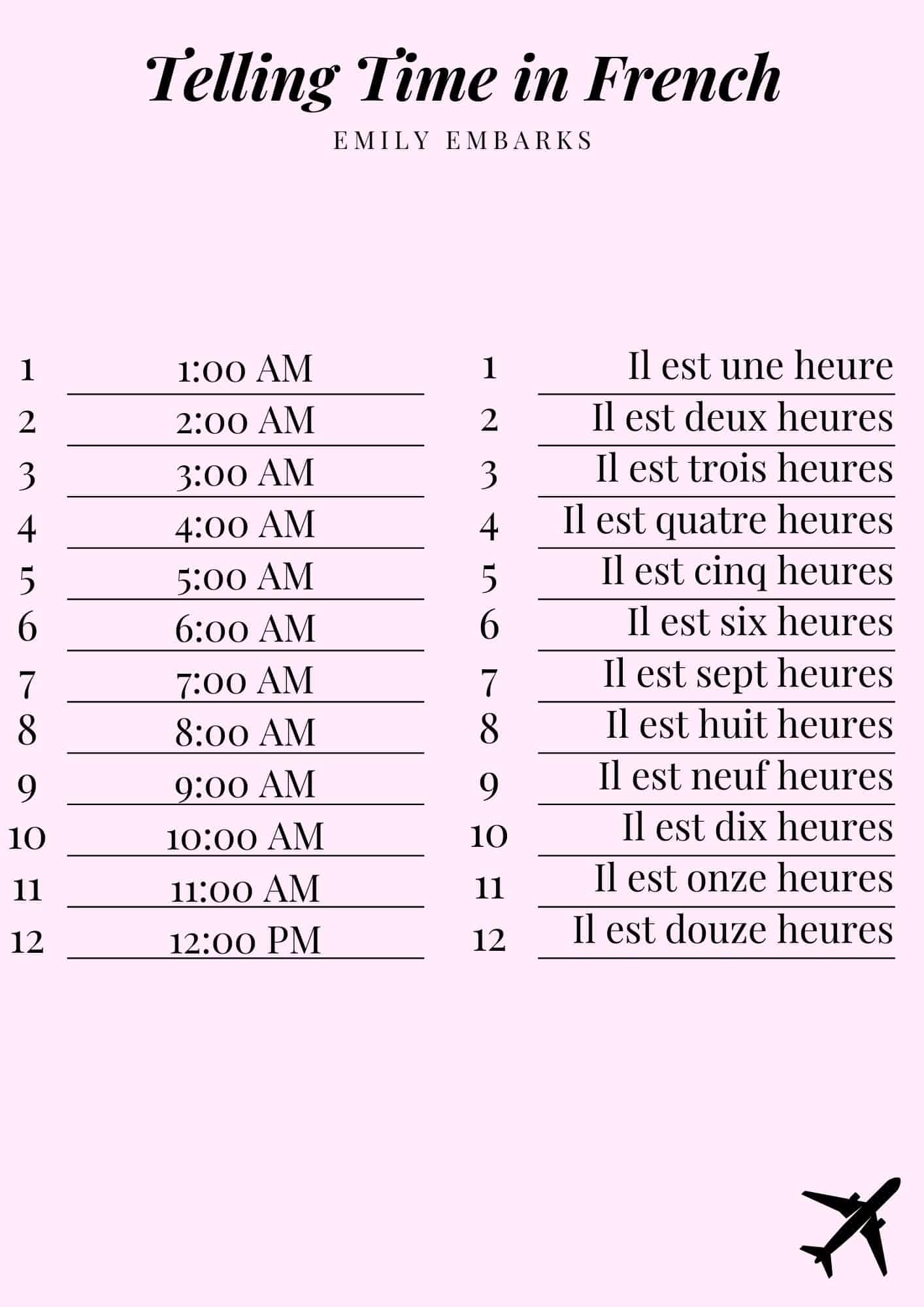

Now, this is a very basic introduction to telling time in French and again, if you aren’t familiar with the French number system, this is going to get very confusing.
Be sure you are very comfortable with counting in French before beginning this lesson so you don’t get overwhelmed with the material.
Since the French use the 24 hour clock like we previously talked about, you’re going to need to memorize numbers 1-24. You’ll also need to know numbers 1-59, but we’ll get into that a bit later.
For now, practice your pronunciation for telling time from 1:00AM to 12:00PM. Notice how all of the sentences are the same and the only difference is the number of the hour? This makes it very convenient for you!
But, once you get onto the right form you can see that the 24-hour clock now requires the addition of 12 to our first set of numbers. 1:00PM actually translates to “the thirteenth hour” and 2:00PM actually translates to “the fourteenth” hour.
Practice and understand this concept using numbers in English first if you aren’t familiar with the 24-hour clock before moving on to doing it in French.
12-Hour Clock versus the 24-Hour Clock in French

It is very natural for French people to use 24-hour time in French, so if you are from the Western region and still use a 12-hour clock, simply subtract 12 from the number.
If they tell you it is 15:00, then subtract 12, it is actually 3 o’clock in the afternoon. This only works for numbers 13-24. Thus, one o clock in French is simply une heure.
Using the 24-hour clock allows people to know right away if you are talking about the morning or afternoon hours. Otherwise, your answer would be far longer if you always had to say “in the morning” or “in the evening” after every hour of the day.
In France, and most of Europe for that matter, you will find everyone using the 24-hour clock.
This may be something to get used to if you are coming from America where we call it “military time”, but it’s very simple to learn and shouldn’t take you much time.
How to Give the Time in French

Once you know how to tell the time in French, you can then begin to give the time in French. But, this will only happen after you have mastered numbers 1-59 and can provide answers using common phrases like half past, quarter of, and so forth.
If you want to tell someone it is 3:30 in the afternoon, you would say “Il est quinze heures trente“. While some people prefer this form since it is more proper, you will hear most people simply using the phrase for half-past 3.
While people say it is half past 3 in English, in French, however, they say it is 3 and a half.
So, to tell someone it is 3:30 in the afternoon, you would say: Il est trois heures et demie (this is the most common expression of time in French)
✔️ The phrase, et demie, means half past.
To tell someone it is 3:15 in the afternoon, you would say: Il est trois heures et quart
✔️ The phrase, et quart, means quarter past.
To tell someone it is 3:45 in the afternoon, you would say: Il est trois heures moins le quart
✔️ The phrase, moins le quart, means minus one quarter.
Those clever native French speakers! See how instead of making you use the full phrasing for each long-syllabled number, you can simply say quarter past, half past, or minus one quarter (which is the same as quarter til’).
Now, what about if you want to tell someone it is 3:36 in the afternoon? Well, now you need to know how to count from 1-59!
To say it is 3:36PM, you would say: Il est quinze heures trente-six
✔️ When creating a specific time, always put the hour (3PM) before the minute (36)
For example:
✔️ 8:20AM – Il est huit heures vingt
✔️ 5:00AM – Il est cinq heures
✔️ 3:10PM – Il est quinze heures dix
✔️ 5:12AM – Il est cinque heures douze
✔️ 7:00AM – Il est sept heures
✔️ 9:00AM – Il est neuf heures
✔️ 10:15AM – Il est dix heures et quart
Here are some more examples to help you:

If you prefer to read listen when you learn like I do, I highly recommend spending some time watching this French video. Alexa is a great teacher and will help explain these same concepts so you have multiple methods of learning!
Telling Time in French Practice
If you want to practice your skills, download my free time in French PDF worksheet so you can write in the answers to all of the times on the left-hand side!
FAQ
How Do You Say At What Time in French?

To say “at what time” in French, you would use the phrase à quelle heure?
This is another literally translated phrase, with à meaning at, quelle meaning what, and heure meaning hour or time.
How Do You Say All the Time in French

To say all the time in French, you would use the phrase tout le temps.
“Tout” means all and “le temps” is literally translated to the time.
What is a Formal Way of Asking What Time Is It in French?
A formal way of asking the time in French is “Avez-vous l’heure?”
What is the Best Way of Asking What Time Is It in French?
If you’re a tourist just trying to stick to the basics, then I recommend using “Quelle heure est-il?” to ask the time in French. While the other forms of this sentence can be useful, everyone will understand you and you won’t be perceived as rude or impolite.
Quelle heure est-il is the best way of asking the time in French.
How do you Respond to Quelle heure?

When you want to respond to someone asking the time in French, you can use the phrase “Il est # heures” which literally translates to “It is # hour”. Once translated, however, we understand that the person is saying “It is 3:00PM, 4:00PM” etc.
So, to say it is 3:00pm, you would say “Il est trois heures” if you were using the 12-hour clock (far less common) or you would say “Il est quinze heures” if you were using the 24-hour clock (military time).
Remember that the word heure transforms into the plural form of heures after 1:00AM. So, you would say Il est une heure for 1:00AM versus Il est deux heures for 2:00AM.
Now, this is the most standard and most basic way of responding to someone asking the time. If you want to be able to give exact numbers, perhaps 2:30PM or 1:55AM, then check out the section below on giving exact times in French.
Are There Many Ways to Ask What Time It Is in French?

Yes, in fact, there are actually dozens of ways to ask what time it is in French! In this post, you’re only going to learn about 11 or so of them, but you can actually ask the time in plenty more ways than I am going to talk about.
This is simply because many of them use French slang or aren’t grammatically correct, which can be especially confusing for new learners.
Sayings like “you got the time?” and “what’s the hour?” are often used between French teenagers and young adults, but if you were to say these to someone you don’t know well or to someone who is older, it can come off as rude and touristy.
Hence, why we won’t be learning about these ways of asking the time in this post.
What Time Is It in French Paris?
Did you know that France owns numerous territories across 12 different time zones? Yes, your question was just validated.
Luckily, the time zone across France is the same throughout the country, so the time in Paris is going to be the same time as it is in Normandy, Lyon, Colmar, the wine regions, and so on.
Other Helpful French Resources
If you want to learn more French, check out these helpful articles:
✔️ How to Say Nice to Meet You in French 15+ Ways
✔️ Saying No in French 30+ Ways (& Audio Pronunciation)
✔️ 33+ Ways to Say Thank You in French (with Audio)
✔️ Good Night in French 17+ Ways (& Audio Pronunciation)
✔️ Good Morning in French: 17 Helpful French Greetings
✔️ Merry Christmas in French 17+ Ways
I hope this article helps motivate you to continue learning new languages, especially French, and you found it useful! If you want to keep holding yourself accountable for consistently learning new French vocabulary and want to continue practicing grammar, masculine and feminine forms, etc., I highly recommend trying out Duolingo!
It’s a free language-learning platform that allows both beginner and advanced students to practice their writing, speaking, and listening skills and I use it every single day.
Because no matter what your goals are for learning the French language, whether you are doing it to pass the time or to become fluent, learning how to say what time is it in French is very useful.
